
Why are so many people — talented, accomplished people — quietly checking out of work? And what can leaders actually do about it?
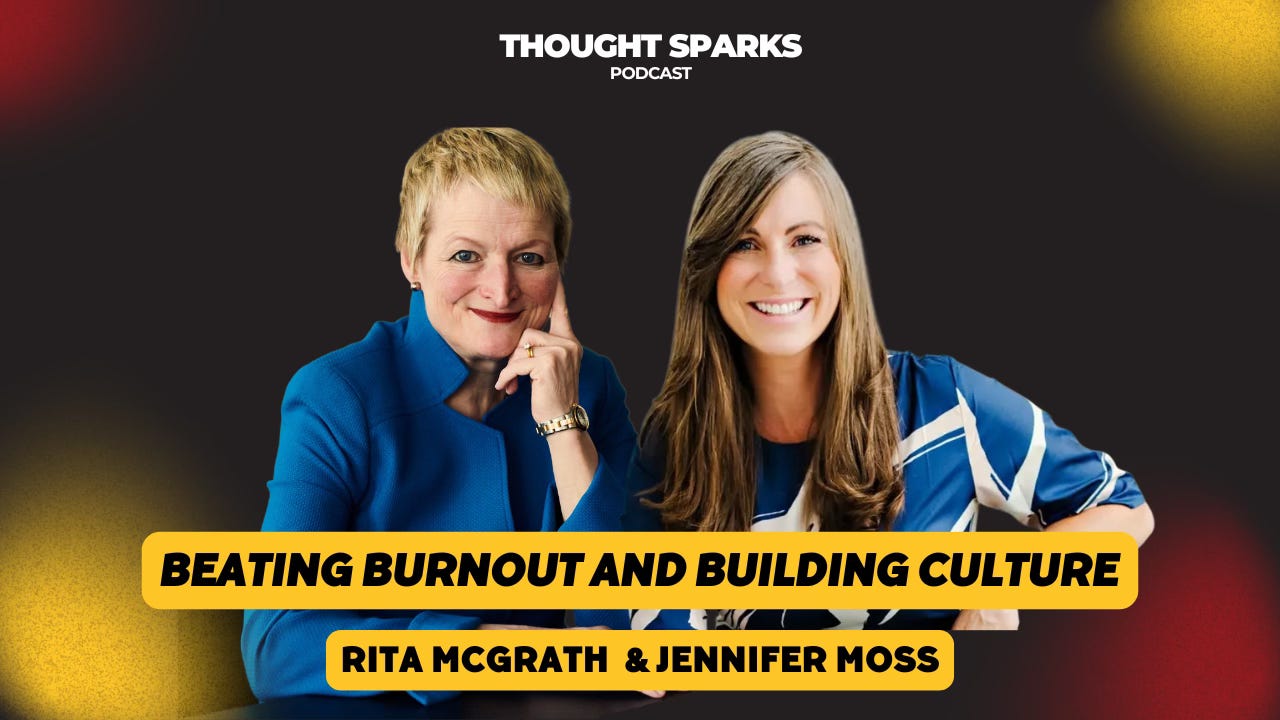
This week’s guest on the Thought Sparks Podcast is Jennifer Moss, author of Why Are We Here? Creating a Work Culture Everyone Wants, and someone who has spent years on the front lines of this question: literally interviewing Uber drivers, CEOs, military leaders, and frontline workers to understand what’s really going on beneath the surface of our workplace malaise.
The purpose gap is bigger than you think.
Jennifer shared research from McKinsey showing that roughly 85% of senior executives feel they’re living in alignment with their purpose on a regular basis, while only about 15% of frontline workers feel the same way. And the troubling part is that leaders make policy decisions based on their own experience of work, not the actual experience of the people they’re leading. The return-to-office debate is a perfect example. As I said to Jennifer (and I’ll stand by it): if you’re a CEO, the office is a pretty great place. Your jokes are funny, people bring you coffee, you feel the energy of the place. Go home, and your spouse is asking you to take out the garbage. The office is clearly superior! But that’s not most people’s reality.
Hope is not soft. It’s a strategy.
This was the reframe I didn’t expect. Jennifer opened her book with hope as a foundational element, and I’ll admit my first instinct was a bit skeptical. Hope feels personal, internal, not something you can operationalize. But she made a compelling case, drawing on cognitive hope theory and her interviews with military leaders, that hope is about goal-setting and goal-achieving. It’s measurable. It’s buildable.
And critically, it’s what you need before you can ask people to do anything ambitious. She also drew an unexpected connection to fertility rates with the research showing that when journalists asked people why they weren’t having children, the most consistent answer wasn’t economic. It was: I don’t feel hopeful about the world I’d bring them into. Hope, it turns out, is a macroeconomic variable.
Purpose washing and the real importance of friendship at work
Jennifer pushes back on what she calls purpose washing which is the idea that every employee should be deeply moved by the company’s mission. The truth, she says, is that for a lot of people, purpose at work shows up through friendship, rituals, community, and the sense of a job well done. Citing Robin Dunbar (of the Dunbar number), she made the point that the workplace used to be the village, and as that village disappears, we haven’t replaced what it provided. Her prescription isn’t a new mission statement. It’s lunch together. It’s actually knowing your colleagues.
There was also a wonderful thread running through our conversation about dematerialization — which, as you might expect, I couldn’t help but weigh in on. When work is intangible, it’s harder to feel the satisfaction of having made something. Jennifer had interviewed Martin Seligman, who made the point that humans derived meaning from work when it was tangible and immediate. You fixed your roof, youfelt good. We’ve moved so far from that that our brains are struggling to compute the shift. This resonates deeply with what I’ve been thinking about for my new book. The psychological dimension of a dematerializing economy deserves a lot more attention than it gets.
And on AI: Jennifer had some pointed things to say about the current moment. She noted that by most measures, AI has not yet moved the needle on productivity or GDP, and yet we’re displacing workers and undermining trust at the very moment we need people to engage with new technology. I offered the analogy of factories and electricity: it took 40 years for factories designed around steam power to fully give way to factories designed around electricity. The early adopters of electricity-first design did dramatically better, but the bulk of legacy infrastructure took decades to turn over.
We’re doing something similar with AI. We’re inserting new capabilities into old processes and then wondering why the ROI isn’t there.
This is a rich, warm, and genuinely practical conversation. Jennifer’s book is one you can open to any page and find something actionable — which, for a book about workplace culture, is a meaningful achievement.
The full episode drops on May 19. I hope you’ll give it a listen.
Warmly,
Rita