
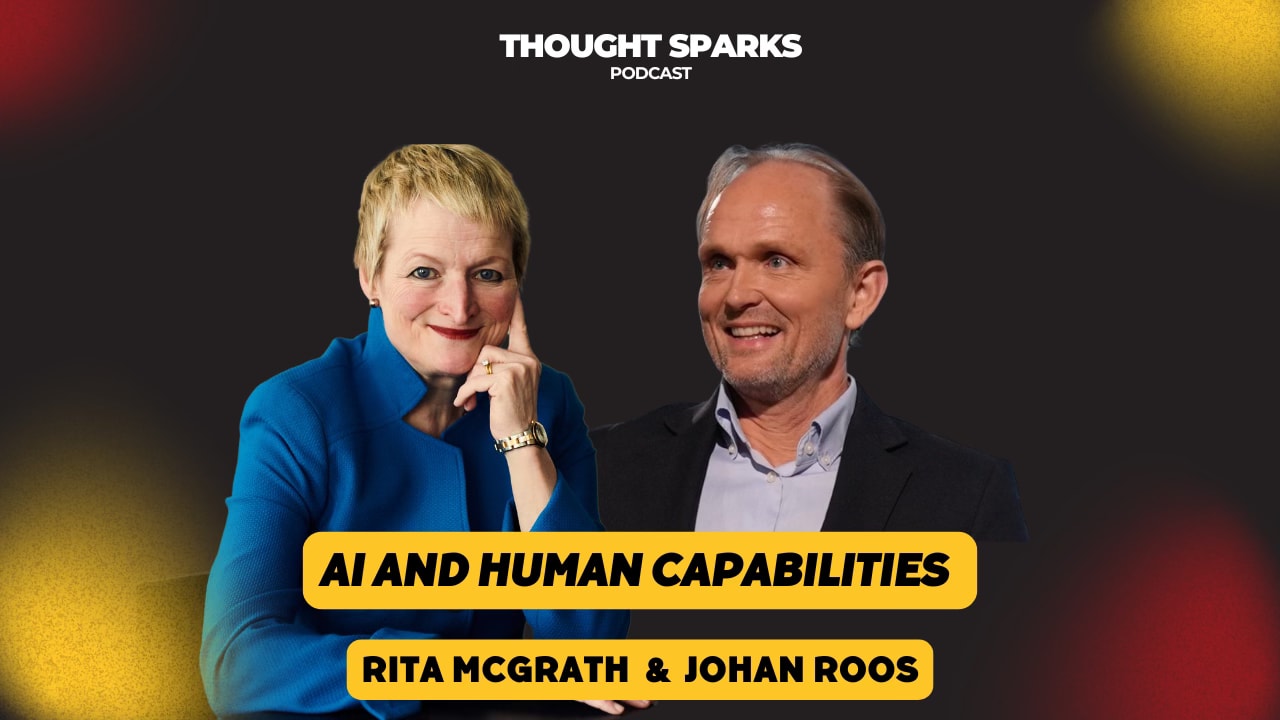
I’ve known Johan Roos for close to thirty years. We first crossed paths when he was developing LEGO Serious Play with his colleague Bart Victor — a concept that turns out to unlock something profound about how humans think and communicate together. Since then, Johan has served as Global Chief Academic Officer at Hult International Business School, been a driving force behind the Peter Drucker Forum, and continued developing sharp ideas about leadership, strategy, and what it means to be human in organizations.
His new book is called Human Magic: Leading with Wisdom in a World of AI. We recorded a conversation for the Thought Sparks podcast, and I thought I would share some of the timely and topical ideas from that conversation.
The Central Question
Johan’s book opens with what he calls “our choice”, and he means that quite literally. Not the choice of policymakers or technology companies, but the choice each of us makes, every day, about how we relate to AI tools. The question is: are we using these technologies to amplify what’s distinctively human, or are we allowing them to quietly erode the capabilities that make us irreplaceable?
In one kind of future, AI strengthens our judgment, sharpens our creativity, enriches our communication, and deepens our capacity to collaborate. That’s amplification. In the alternative, we gradually delegate our thinking, the questioning, the sense-making, until the muscles atrophy. That’s erosion.
The process isn’t dramatic: the erosion is subtle and incremental, and you won’t notice it happening. Each time you accept an AI-generated summary without really reading it, each time you let an algorithm decide what’s worth exploring, each time you send the LLM-drafted email without bringing yourself to it – small choices, quietly compounding.
As a metaphor, you can take the elevator or the stairs. If you always take the elevator, eventually you discover you can’t climb the stairs. The capability doesn’t disappear all at once, but it just gradually isn’t there when you try to call on it.
Toward Practical Wisdom
Human magic manifests itself in what Johan calls “practical wisdom”, which allow people to exercise wise and appropriate judgment in uncertain situations. Four erosion mechanisms threaten this capacity. The first is automation bias, in which algorithmic confidence displaces situational perception. It’s sort of like following the GPS even if you suspect it is taking you over a cliff. The second is rule dependence, in which procedures eliminate discretion and are fundamentally stupid – in that they were designed for a situation that is no longer appropriate. The third is the loss of skill building, in which AI-smoothed pathways eliminate the struggle through which judgment develops, with all of its exhaustion and feedback loops. Finally, we have moral outsourcing, where diffused accountability enables avoidance of ethical ownership.
Practical wisdom draws on five foundational human properties.
Curiosity. Socrates famously told a young mathematician that perplexity — genuine confusion — is the true beginning of philosophy. When AI gives us polished conclusions in seconds, we can lose productive struggle and genuine learning.
Creativity. There’s a big difference between sharp creativity that leads to breakthroughs and vast amounts of AI slop. Leonardo da Vinci’s remarkable ability to blend art and science led to breakthroughs in areas as diverse as flying machines and armored vehicles, as well, of course, as producing art that influenced generations.
Critical Thinking. When an AI can spit out a confident sounding answer, it’s all too easy not to dig beneath the surface to see why it came to the conclusions it did. Getting out of the habit of looking for multiple sources, finding complex supporting data and making sure assumptions are documented and tested can be dangerous.
Communication. Here, Johan suggests we prepare with AI (research, structure arguments, stress-test your reasoning), then perform without it — full human presence, devices off.
Collaboration. Some human groups created shared consciousness, a deep form of “heedful interrelating.” Using AI instead of deep dialogue, shared trust and a common purpose can erode this capability.
Where are new human skills going to come from?
Gutting junior talent to capture AI efficiency gains may be storing up serious problems. Junior employees aren’t just doing tasks, but are building judgment through apprenticeship. The work of building proficiency by doing, getting feedback, doing again is irreplaceable. You cannot shortcut it.
Organizations that thinned out their junior ranks in 2023 and 2024 are starting to discover unintended consequences. There are parts of even junior jobs that AI can’t do, so that work migrates onto more senior people’s desks. The mentoring that made senior roles meaningful evaporates. We may well be building a wisdom gap that no amount of AI can fill.
Johan put it well: we overestimate the short-term consequences of technology and underestimate the long-term ones. This is one of the long-term ones.
The good news, and this is Johan’s insistence throughout the book: the erosion is not inevitable. It is a choice. A daily choice, made in small moments, in how we use these extraordinary tools.
Use the elevator when you need to. But climb the stairs too.