
Dear subscribers,
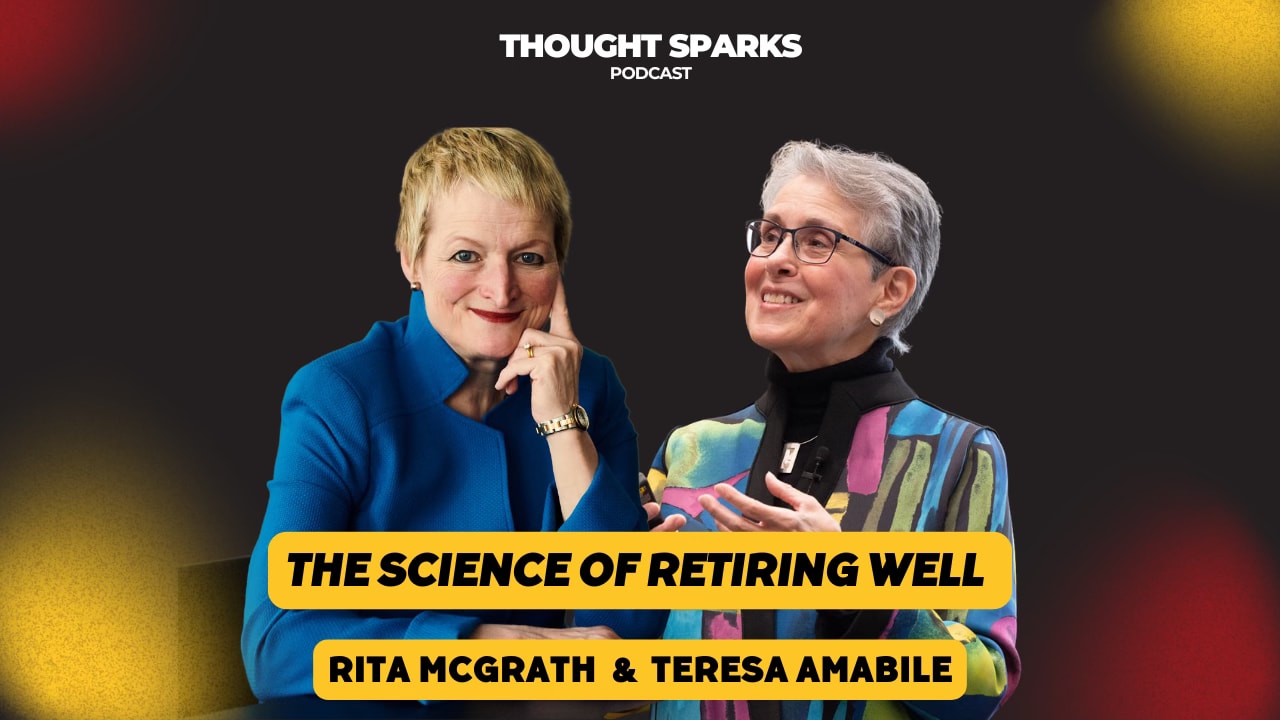
This week’s Thought Sparks Podcast episode is one I’ve been looking forward to for a long time. Teresa Amabile — emerita professor at Harvard Business School, creativity scholar, and a dear friend of many years — has turned her rigorous research lens onto one of the most consequential transitions any of us will face: retirement.
Her new book, Retiring: Creating a Life That Works for You, is unusual for a book about retirement, in that it doesn’t focus so much on the financials of preparing, but on how your life looks life after you’vepulled the trigger on the decision. Teresa and her co-authors conducted over 215 long-form interviews — some running as long as three hours — with 120 people, including a core group of 14 “stars” they followed longitudinally from the lead-up to retirement through the first years of living it. The result is the closest thing to an evidence-based map of this transition that anyone has produced.
Here are some of the highlights.
The progress rinciple, and what happens when work ends
Teresa’s last big project was The Progress Principle, a study based on nearly 12,000 daily work diaries that found the single biggest driver of people’s wellbeing, motivation, and creativity on any given day is simply making progress in meaningful work. Even tiny forward steps matter enormously.
That finding led directly to the question she couldn’t stop thinking about: What happens when meaningful work ends? For people in corporate careers (unlike us academics, who can keep writing into our eighties if we want) retirement means the work doesn’t just slow down but stops entirely. She told me her husband jokes that she couldn’t retire until she finished the research because she wanted “an evidence-based retirement.” That’s Teresa in a nutshell, and this episode has her fingerprints all over it.
The four tasks: Why success in retirement is a job in itself
One of the most surprising findings from her research is that successful retirement is a process that requires real effort. Teresa describes four tasks everyone navigating this transition should be prepared to engage with:
-
Making the decision. The “when” turns out to be harder than almost anyone expects. Teresa shares the story of one participant — a high-achieving executive she calls Irene — who made and unmade her retirement decision four years in a row. What was really holding her back? An identity question she hadn’t yet named: People still respect you while you’re working. Maybe not so much after. Once she could see that clearly, she could act on it.
-
Detaching from work. The practical checklist — the HR paperwork, the laptop return, the ID badge — is the easy part. The psychological detachment, especially from a professional identity built over decades, is something else entirely. We hear about Jay, a consulting firm partner who technically retired but kept doing contract projects for nearly five years because his identity just wouldn’t shift until he finally cut the cord completely.
-
Exploring and experimenting. This is the task that separates the people who flourish from those who struggle. Teresa shares the cautionary story of Lawrence, who had good intentions — Habitat for Humanity, teaching project management at a local college — but when retirement actually arrived, he didn’t make a single phone call. Further, he and his wife had moved to be near their grandchild, not realizing that this meant leaving behind meaningful relationships with friends and the normal routines and distractions they had built up over the years in their community. They drifted into inertia, then eventually into destructive alcoholism. Things came to a crisis when their family staged an intervention, threatening to cut off all ties between them and their beloved grandchild if they didn’t address the issues. Rocked by this, then went into rehabilitation and fortunately the story ends well. They achieved sobriety, rebuilt relationships, and enjoyed their fiftieth anniversary, but their inaction and inertia took them right to the brink of what could have been disastrous.
-
Consolidating a retirement life. The fourth task is making deliberate choices among the things you’ve experimented with and settling into a rhythm. It sounds straightforward, but Teresa describes participants who were five years into retirement and still felt unsettled because they hadn’t managed to make certain fundamental decisions about their lives.
The identity question: bridging and building anew
For high-achieving people, professional identity isn’t just a job title, but often a load-bearing wall. So how do you restructure without the whole thing collapsing?
Teresa describes two mechanisms she observed in the people who navigated this best. One is identity bridging: carrying some essential piece of who you’ve been across the transition in a new form. One retired executive became chair of his church’s board of trustees and led a major capital campaign. He wasn’t leading a company anymore, but he was leading and his hard-won skills had a new home.
The other mechanism is recovering an identity that work had crowded out. Jay the consultant became a passionate hot-rodder in retirement which he’d loved in his twenties that his career years had left no space for. Through that community, he built more genuine friendships than he’d had in decades of corporate life.
One thing companies still aren’t doing
We talked about the organizational dimension of all this, and I found Teresa’s observation to ring true. To the extent that companies provide any support for their retirement-ready populations, they tend to begin and end with financial planning workshops. Almost none offer any preparation for the psychological, relational, and identity dimensions of the process. One thing nobody seems to be thinking about is that we’re on the brink of a tidal wave of baby boomer retirements. That’s a lot of tacit knowledge about to walk out the door. By being more proactive about the human side of retirement, companies might well find it gives them an advantage in helping valuable talent taper off and bring along the next generation.
The company models that worked best treated retirement as a transition process, not an event. One organization Teresa describes allowed employees to sign an 18-month contract to work three days a week, paid for four, before officially retiring. People loved it — and so did the companies, because the knowledge transfer was planned for rather than left to chance.
And then there’s Teresa herself
When I asked Teresa about her own surprises since retiring about 18 months ago, her answer wasn’t what I expected. She planned her book tour, the talks, the podcast circuit. What she didn’t plan — and what’s now occupying at least as much of her time — is that she’s become a democracy activist, using her writing and teaching skills in a direction she never anticipated. It’s a perfect illustration of her own finding: be forward thinking about planning your framework, and then life can fill in new things.
The full conversation is rich with stories, specific tools (including the visual “life maps” that are one of the most practical things in the book), and advice that applies whether retirement is twenty years away or already in progress.
I think you’ll love it.
— Rita
The Thought Sparks Podcast episode with Teresa Amabile drops tomorrow, April 21, anywhere podcasts are found. Teresa’s book, Retiring: Creating a Life That Works for You, is available now, and her team offers resources, exercises, and life map examples at retiringbook.com.