Dear Subscribers,
As ever, subscribers get an early heads up when a Thought Sparks Podcast interview is released.
If your meetings were a product, would you ever ship them?
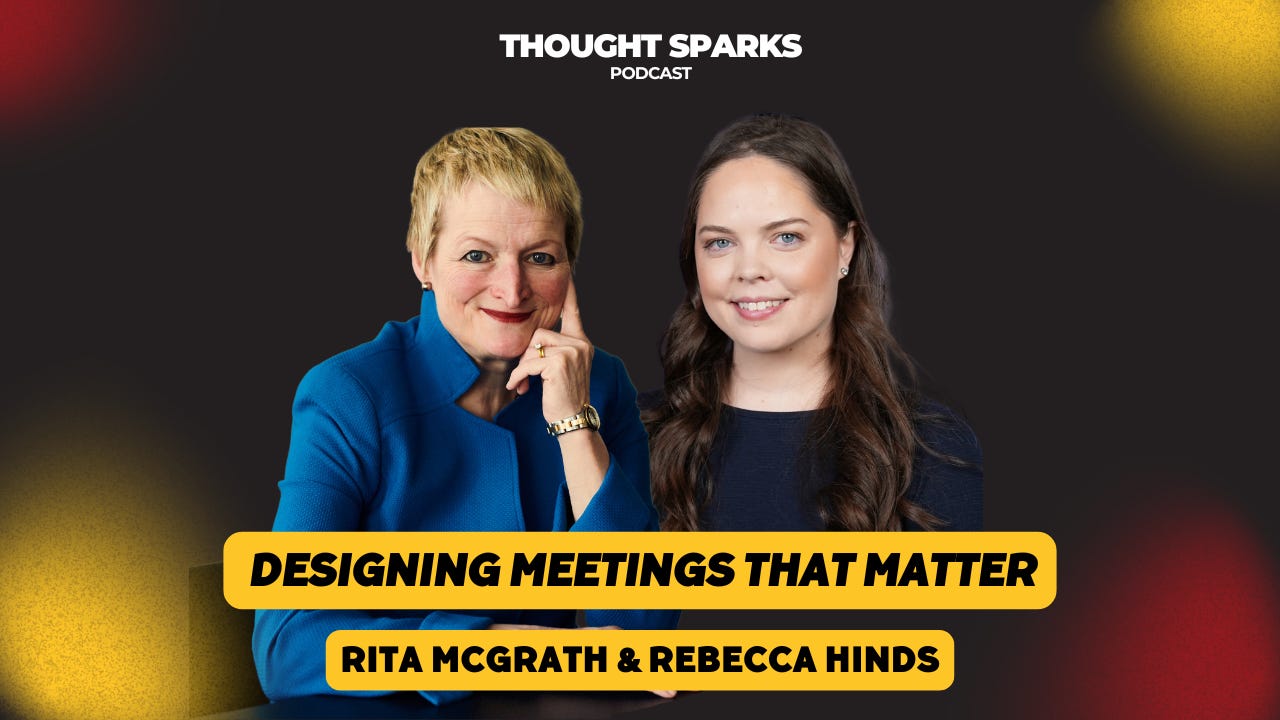
My guest is Rebecca Hinds. She’s a lecturer at Stanford, head of the Work AI Institute at Glean, and author of the most useful book Your Best Meeting Ever. Her central claim is that meetings are the most important product any organization makes. They are where decisions get made, where culture is built or broken, where alignment is set. And they are, almost without exception, the least well designed product in the building. We would never put a customer through what we routinely put our own people through.
Is she ever right! In our conversation, I mentioned my experience of walking into the headquarters of a large industrial company one morning at around half past eight and finding thirty people arranged around an enormous conference table. I went for coffee at nine-thirty; same thirty people. I came back at ten; same thirty people. They were still going when we broke for lunch. Rebecca was not remotely surprised. Meetings, she says, are our lazy default for any problem or any uncertainty. Even worse, they have become a status symbol. If you’re always in meetings, surely you are super-important! They are the most visible manifestation of power in an organization, which is why getting rid of them can be surprisingly difficult.
A few of the things we get into:
-
Meeting doomsday — a forty-eight-hour calendar cleanse in which employees, not HR, wipe the slate themselves and rebuild from scratch. I love the idea of giving people a reason to get rid of useless meetings and that it isn’t unilateral disarmament. Everybody has to do it, no excuses. It’s a powerful antidote to the meeting status quandary.
-
Return on time invested — a two-question survey after roughly one in ten of the meetings you run. It’s three minutes of work for the participants, but gives you a trove of information, such as what worked and what didn’t and who needed to be there, and who didn’t.
-
The four D-CEO test — a meeting earns the right to exist only if it is to decide, debate, discuss or develop people, and only if the content is genuinely complex, emotionally charged or is very consequential. They call these kinds of decisions “one way doors” at Amazon, because getting them wrong is consequential, hard to reverse and significant. Two way door decisions? Leave it to the people directly involved.
-
Bike-shedding — The term comes from an old English story about a meeting agenda that involved a major decision about establishing a nuclear plant and a decision about setting up a bike shed. What did the decision makers talk about? The bike shed. Why? Because it was so much easier to understand than the complexities of nuclear power. It’s an apt metaphor for why we spend the most time on the least consequential item on the agenda. I have personally observed a Board of a large retailer that spent half a meeting discussing what should be in the Easter basket sent to clients that year!
-
Start every agenda item with a verb — a cheap, fast diagnostic that tests whether your meeting has a clearly defined purpose. “Budget line item” commits you to nothing. “Approve the Q4 reallocation” commits you to something.
-
Why hybrid meetings are the hardest of all — and the study out of China involving robots with a balloon that swells the longer a remote colleague has gone without speaking. You will want to hear that one described.
We also spend a good while on AI. Rebecca is less interested in another tool that summarizes your meeting than in something subtler: technology as a way to take the guilt and the power dynamics out of declining one. It is very hard to tell a senior person that their meeting is a waste of your time. It is much easier when the machine is the one saying it.
Three things you could act on this afternoon: keep yourself under ten hours of meetings a week, start every agenda item with a verb, and run the next thing you are about to schedule through the four Ds. These are small moves that could give you an immediate return.
The full episode drops on Tuesday. If you spend an inordinate amount of your working life in conversations that you know could have a much greater impact, this one is for you.
Warmly,
Rita