
What the science of decision making highlights about how digital innovations are changing our world, and more insights from the first month of 2026.
Despite a widespread and pervasive pro-innovation bias (if it’s new and improved, it must be good, right?), every so often a moment comes along that causes quite a lot of people to say, “hmmm?” That’sparticularly the case when the byproduct of truly useful innovations can be harmful in some way. Even worse, when the power that revenue from popular innovations gives their originators leads to their having an outsized say in what society considers to be OK and what not.

Eventually for some product categories, things come to an inflection point. That’s when individuals and groups emerge to weigh in on the “this is not OK” side of things, pressing courts and eventually legislators to take action. We saw it with “Unsafe at Any Speed: The Designed-In Dangers of the American Automobile.” This book put a young Ralph Nader on the map for making the dramatic argument that automakers prioritized style and profits over passenger safety.
As the New York Times notes, “Less than a year after the book was published, a balky Congress created the federal safety agency that became the National Highway Traffic Safety Administration — an agency whose stated mission is to save lives, prevent injuries and reduce crashes.” And despite being far from perfect, implementation of measures we take for granted today – seat belts, air bags, and crash protection features – have made an enormous difference. As the National Safety Council reports, “In 1923, the first year that miles driven was estimated, the motor-vehicle death rate was 18.65 deaths for every 100 million miles driven. Since 1923, the mileage death rate has decreased 93% and now stands at 1.38 deaths per 100 million miles driven.” Even those who were begrudging about the role of government in dictating what private companies could do acknowledge the success represented by these numbers.
So here we are in 2026 at what might well be an “unsafe at any age” moment for social media and technology companies, with the advent of the first major social media addiction trials. More than 1,600 plaintiffs, representing over 350 families and 250 school districts, are alleging social media companies knowingly designed addictive products that expose kids to danger, predatory exploitation, and self-harm. The defendants in the cases are some of the most profitable companies in history. The trial, which has begun in Los Angeles features 24 “bellwether” cases, to exemplify the harms the plaintiffs charge the companies created.
Here’s where this gets interesting. Unlike many previous attempts to rein in technology platforms, this one doesn’t go after the content (which tech companies always argue they can’t be held responsible for under Section 230 of the Communications Decency Act). Instead, the plaintiffs are arguing that the harm done by social media companies is the outcome of defective product design. Moreover, thatexecutives in these companies knew about the harmful features they were propagating and consciously covered up what they knew about the dangers of their products. It’s the same kind of argument that eventually succeeded in taming the worst tendencies of tobacco companies. They went down slugging. Indeed, companies in the tobacco and oil industries used similar techniques and in some cases the exact same scientists to downplay the risks of both smoking and climate change.
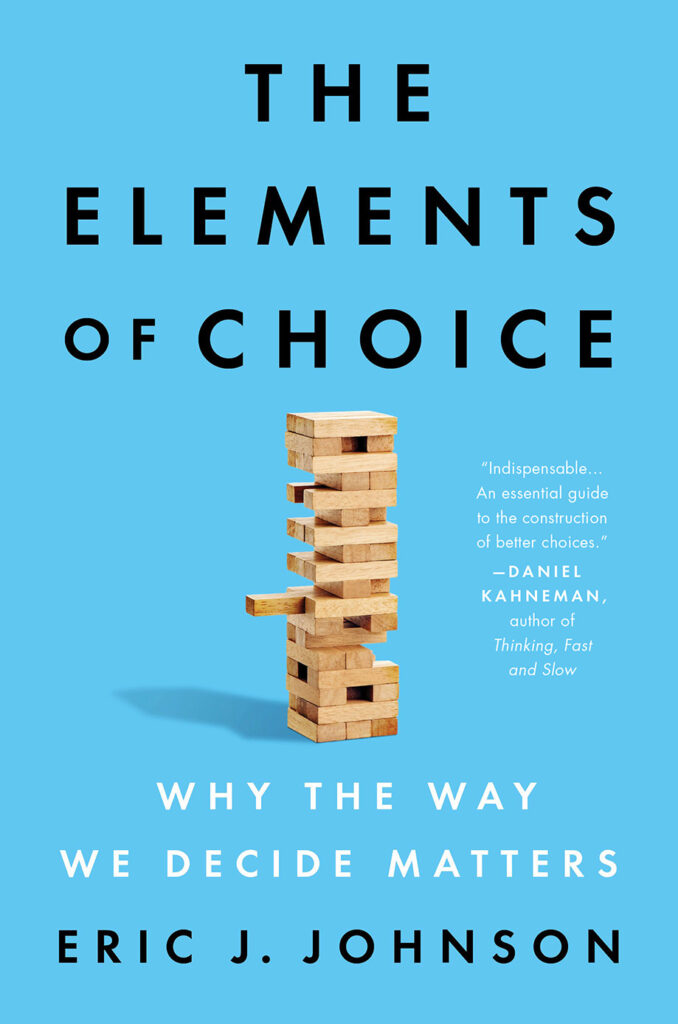
This brings us to the fascinating work of my colleague, Eric Johnson, author of a terrific book “The Elements of Choice.” In the book, he assembles a massive amount of research that suggests that how choices are presented to us makes an enormous difference in the decisions we ultimately make. This is the role of choice architecture. Here is his point: whether architected skillfully or not, with intention or not, to achieve an economic outcome or not, all choice situations are architected.
Those who understand the way human brains work and design the choice architecture accordingly can reap disproportionate benefits for themselves. This is why it is super-easy to subscribe to something and an incredible pain to cancel the subscription. Why defaults are set in such a way that they favor the company setting them. Why Google is happy to pay Apple north of $20 billion to be the default search engine on iPhones. You can watch my podcast with Eric that goes into these issues.
This idea, that of known choice architecture, is at the core of this case. The plaintiffs argue that features such as infinite scroll, auto-play videos, frequent notifications and recommendation algorithms are deliberately designed to be addictive, particularly for younger minds. Jonathan Haidt, author of “The Anxious Generation” has made a similar argument based on rising levels of mental distress among young people and has sparked a movement among many schools, families, and in the case of Australia, even governments, to ban smart phones below the age of 16.

This is where the parallels between government regulation of the auto companies and what might come out of these trials is instructive. Even as self-reported “car guys” fought against, complained about and very reluctantly went along with government requirements, the fact that the costs were imposed on all automakers uniformly meant that there was no competitive disadvantage to those who wanted to make safer products. There were also across the board benefits to users who avoided the harmful outcomes that could come from using those products. What the plaintiffs are looking for is not content moderation or a tweak here and there, but a fundamental rethink of how powerful technologies that can hijack our brains are allowed to operate in the world. The outcome will be interesting to observe, indeed.
January Events
Holidays over, and back to the classroom for sessions with a major Asian development bank, the leadership of a huge New York area hospital system and a very high-level group of Chief Supply Chain Officers. The conversations, even with this diversity of participants, all touched on the dissolution of certainty in our old word order, the increased level of unpredictability in their environments and how to remain calm, healthy and centered amidst all the chaos.
We recorded a whole slate of new episodes of the Thought Sparks Podcast, featuring authors, industry leaders, and those who are truly innovating in their fields. New episodes are released every Tuesday at 11 am EST. Episodes releasing this spring include Sylvia Acevedo, former Girl Scouts CEO and literal rocket scientist, Tomas Chamorro-Premuzic, author of Don’t Be Yourself: Why Authenticity Is Overrated (and What to Do Instead); and José Marcilla, President of the Latin America and Canada Region at Novartis.
In the News
How should European fashion leaders position themselves to manage rapidly changing US tariffs policy, and more in Vogue Business.
“Gateway” products solve challenging technical problems and demonstrate what customers are willing to pay for, but are also ripe for disruption, as I explain in Fast Company.
Thought Sparks Podcast
What a great start to the year for the Thought Sparks Podcast! This month, we welcomed Peter Cappelli and Ranya Nehmeh on the ongoing remote/hybrid/in-person work debate, Rob Siegel on systems leadership and the cross pressures leaders face, Cheryl McKissack Daniel on her family’s remarkable 5-generation legacy in the construction industry, and Neri Karra Sillaman, winner of the Thinkers50 2025 Radar Award and expert in what sets immigrant entrepreneurs apart.
Upcoming Events
HBR Strategy Seminar
On February 26, I’ll be giving the kickoff keynote at the HBR Strategy Summit, on how strategy meets the “unbossed” organization. Spots are going quickly for this virtual event – be sure not to miss out!
Columbia Executive Education
How do you drive innovation and growth, amid chaos and disruption? Leading Strategic Growth and Change, my Executive Education course at Columbia Business School, is designed to help executives spot new opportunities early, adapt strategy in real time, and guide their teams through complex transformations.
Join us for weeklong sessions running March 23-27, 2026 and June 15-19, 2026, on-campus in New York. Make sure you save your spot!
SXSW London
I’m thrilled to share that I’ll be joining in the fun at SXSW London in June! With Neri Karra Sillaman, Thinkers50 Radar Award 2025 winner and Mursal Hedayat, CEO of Chatterbox and a Forbes 30 Under 30 Social Entrepreneur, we will be delivering a panel titled Immigration as a Global Innovation Engine: Rethinking Talent, Risk & Reinvention. Stay tuned for more programming surrounding the event in London.