
Conventional strategy had specific rules. When the game was largely about occupying markets in the physical world and dominating over companies doing the same thing you were (how we used to think about competition), you duked it out within existing structures. Now, with the advent of a digital world, AI and de-materialization, you win by changing the structures themselves.
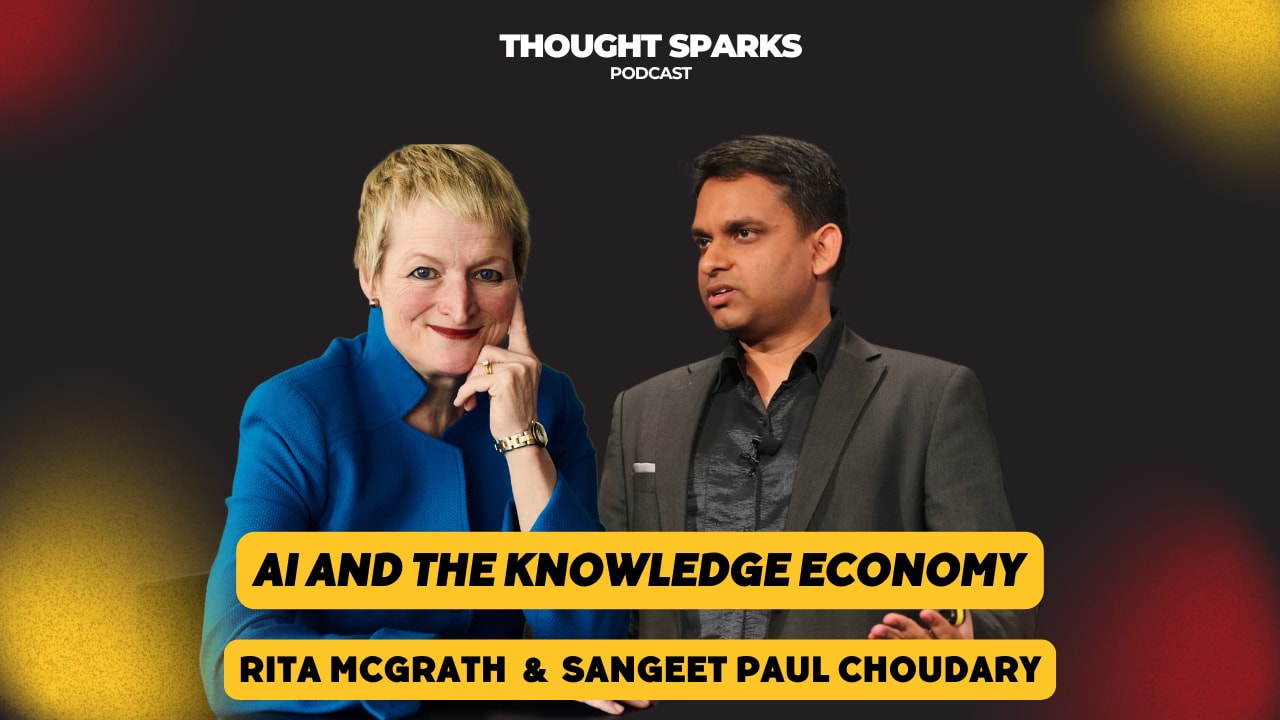
I recently sat down with Sangeet Paul Choudary for my podcast, and it was terrific to chat with someone who looks at the world in a very complementary way to the way I see things. Sangeet just won the Thinkers50 award for strategy, and if you pick up any of his books you’ll easily see why. He’s also one of those people who can connect seemingly unrelated things in ways that aren’t obvious.
Many of you will know Sangeet from Reshuffle, his systems-level examination of what AI means for strategy, the economy, and your career. (If you haven’t read it, the core provocation is this: thinking about AI in terms of the tasks it can perform is entirely the wrong frame. You need the systems perspective. Full stop.)
But here’s a benefit to your subscribing to this newsletter: a first glimpse into Sangeet’s next book, which isn’t out yet. It’s called Unfair Advantage, and the thesis is sharp enough to leave a mark.
From playing the game to changing it
The argument Sangeet makes — and it resonates deeply with what I’ve been working on — is that virtually all the major strategy frameworks developed from the 1970s through the early 2000s were built for a world where the structure of industries was stable. In that world, you faced operational uncertainty: demand fluctuations, supply shocks. But the basic playing field? Fixed.
We no longer live in that world.
Sangeet calls what we face now structural uncertainty — meaning that the boundaries between industries are no longer static. With AI, you can train a model in one industry and port it to another. Scarcity collapses. Value migrates. The whole playing field becomes contested.
And that invalidates a lot of the assumptions about conventional strategy. Take the idea that scale conveys an advantage through learning curve and experience curve effects (looking at you, BCG growth/share matrix!). When you’re in a world where Maor Shlomo, an Israeli entrepreneur created a business, Base44, on his own in 6 months and sold it to Wix for $80 million, tell me what scale even means? So too with the beloved 5-forces model for competitive strategy – when players are both buyers and suppliers, when rivalry isn’t contained within one industry, and when the potential for new entrants is everywhere, where do you even start?
In a stable world, the winning move was positional — occupy an attractive position in an attractive industry, throw up entry barriers if you can, build competences to defend it, and optimize within the rules. Today, the dominant way to win isn’t to play the existing game better. It’s to change the rules of the game for everybody else.
That’s the strategic shift of our era, as I’ve been writing about a good deal. We’re going from the logic of mass production to a logic of digitalization, as Carlota Perez has long said.
The Apple example that reframes everything
One of the most illuminating moments in our conversation was Sangeet’s retelling of how Steve Jobs used the iPod as a calculated move to migrate value across industries. With the 1999 advent of Napster, record labels were suddenly faced with the reality that peer-to-peer file sharing meant that my record collection could be yours at the click of a button. The label executives freaked out. This inadvertently created an opening for Apple. Apple had already opened a “digital jukebox” – iTunes – in 2001, and introduced the iPod, which could allow you to carry iTunes (10,000 songs) in your pocket around the same time. But the real structural change came in 2003, when Jobs negotiated an agreement with 5 record labels that allowed iTunes to legally sell individual songs for 99 cents each. The labels, facing an existential crisis, reasoned that something was better than nothing, which is what they were getting from the vast and growing market for pirated music.
Jobs basically commoditized music (and ended up giving most of that ninety-nine cents back to the record labels). But he moved the value into the device ecosystem, by selling the iPod (remember, the thing was $399 when it was first introduced). But he wasn’t done there. When the iPhone was ready, he commoditized the iPod itself by turning it into an app. Every bit of value he’d accumulated transferred seamlessly into computing, which then reshaped cameras, GPS, maps, and more.
This isn’t a story about cannibalization. It’s a story about value migration — and it requires a completely different strategic lens to see it clearly. As Sangeet put it: if a competitor had viewed what Jobs was doing through the old product-cannibalization framework, they would have missed what was actually happening entirely.
To me, what made Apple remarkable was that, by any conventional management logic of preserving a position, managers would have fought tooth and nail to protect the iPod. It was a wildly profitable franchise. The organizational immune system should have killed the iPhone before it launched. That it didn’t — and that Apple had actually been quietly experimenting with the touchscreen interface on the iPod Touch long before the iPhone existed — is a masterclass in benefiting from transient advantage.
Where our thinking converges
Regular readers will know I’ve been developing the idea that as AI makes it possible for small teams — even individuals — to create enormous value, the rationale for large monolithic corporations starts to erode. What you get instead may be knitted-together ecosystems, each piece doing one specific thing exceptionally well. How do you talk about the value delivered to you by the iPhone ecosystem, with its tightly integrated platforms of software and hardware? The very concept of the firm or even of competitive advantage may no longer be fit for purpose. We may genuinely need new vocabulary.
Sangeet’s idea is that when the playing field itself is up for grabs, the entities that win are the ones who shape it, not the ones who merely optimize within it. The rule-setters and the rule-followers diverge. That’s the split we’re watching happen in real time.
Coming up: Sangeet, Aidan McCullen, and me
One more thing for subscribers: Sangeet and I are also going to be joining Aidan McCullen on his podcast, so there will be more of this conversation to come. Aidan has a gift for drawing out the deeper patterns, so I expect that will go in some interesting directions. Watch this space for the release date – it will be on The Innovation Show.
In the meantime — if you haven’t read Reshuffle, now is the moment. Because Unfair Advantage is coming, and you’ll want the foundation.
Thanks for being here. This is exactly the kind of conversation I built this community for. Please feel free to elaborate in the comments!
Warmly,
Rita