
Dear subscribers,
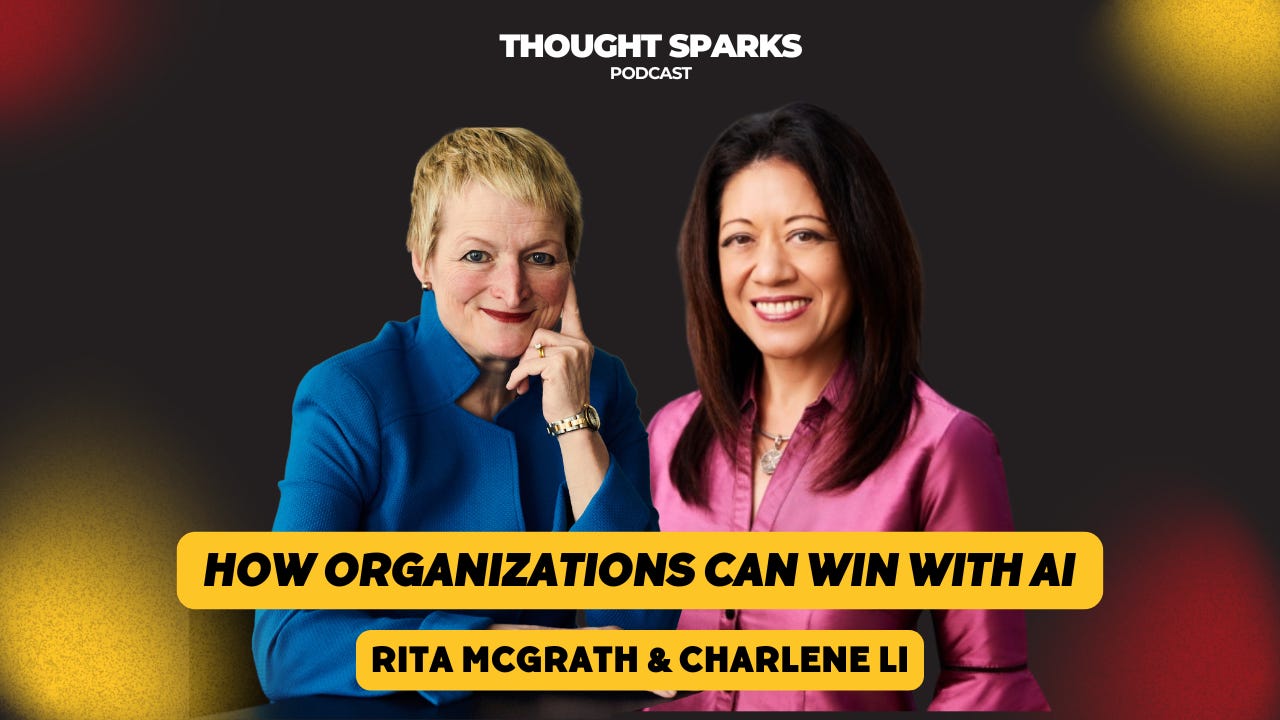
There are some guests who I suspect are being a little careful about what they think. Charlene Li is not one of them! Charlene — fellow Silicon Guilder, author of Groundswell, Open Leadership, and The Disruption Mindset, and someone I’ve traveled the disruption trail with for many years — has a new book out with her co-author Katia Walsh (one of the world’s first chief AI officers, by the way): Winning with AI: The 90-Day Blueprint for Success.
What I love about the book is right there in the title. It’s not “your next century of AI.” It’s not another proof of concept or pilot. It’s 90 days — roughly the window, as Charlene wryly observes, between the board meeting where you’re told to do something about AI and the next board meeting where you have to show up with an answer.
Here’s some of what we got into.
“What do we do about AI?” is the wrong question.
As I’ve been saying for years, you don’t need an AI strategy any more than you need an electricity strategy. You have a business strategy — a center, a mission, and strategic objectives. The right question is how AI can be in service of those. From there you build an AI roadmap, and she offered a memorable phrase: put your strategy in ink, and put your roadmap in pencil.
FOMO has met its match: FOGI.
Charlene has coined a term for what she calls the AI hesitancy gap. Leaders feel the fear of missing out, but they’re staring at dark, murky water and experiencing FOGI — fear of getting in. So they dabble, run another experiment, wait for clarity that never comes. Her point, which echoes everything I’ve learned studying inflection points: the perceived risk of jumping in is wildly overstated, and the actual risk is standing still and becoming a spectator.
Why 95% of AI pilots fail — and why that’s a leadership problem.
We dug into the MIT study finding that 95% of AI pilots failv, and Charlene’s diagnosis is bracing: it isn’t the technology that’s failing, it’s leaders failing to define objectives and follow-on work. Her prescription? Projects, not pilots. Skip the readiness assessment (she and Katia wrote one and threw it out — all it does is tell you you’re not ready and licenses more procrastination). Commit, resource it properly, and then persist or pivot. But move.
The grief and the rage.
This was, for me, the most human stretch of the conversation. I told Charlene about a friend — a serial entrepreneur — whose own developers won’t use AI. She said that what we’re not grappling with as leaders is the sheer amount of grief involved. People built their identities around skills that AI now makes obsolete, and underneath the grief is rage. “I played by the rules, I got the degree, and now you’re telling me it’s worthless?” The majority of Americans believe AI will be more harmful than beneficial. Until leaders demonstrate a shared benefit to the diffusion and adoption of AI, that gap will keep widening.
A counter-story worth knowing: Kinecta.
One of Charlene’s favorite cases is Kinecta, a Federal Credit Union that decided from day one that AI would not be a headcount-cutting tool. They cut errors by 85–90%, reduced training time by 30–40%, used the freed capacity to enter entirely new lines of business — evaluating non-performing loans for law firms, work that was previously uneconomic — and recently announced they’re increasing headcount by 5%. That’s what it looks like to treat people as drivers of growth rather than poorly performing robots.
Goldilocks governance and the playground paradox.
Charlene loves governance (Katia, having lived it, wants nothing to do with it — their dynamic is delightful). Her framing: bad governance kills speed, good governance creates it. Like a Formula One car, you can only go as fast as you can stop. And her playground paradox is one of the best guardrail metaphors I’ve heard: put a fence around a playground and the kids play right up at the fence; take it away and they huddle in the center, unsure how far is safe to go from the others. Clear guardrails don’t constrain experimentation — they unleash it.
One practice you can steal tomorrow.
Start every meeting by asking: “How did you use AI to prepare for this meeting?” Then show them how you did. You model the behavior, set the expectations, and remove the stigma that using AI is somehow cheating — a stigma Charlene and I both notice falls especially hard on women, who’ve been trained to believe that being seen working harder is what gets rewarded. (Ladies, repeat after Charlene: work alone does not get you recognized).
There’s much more in the full episode: the three buckets of AI value creation and why automating your existing inefficiencies is madness; her portfolio approach of quick wins, momentum makers, and strategic bets; speed as the last truly defensible moat; “minimally viable data”; the moment AI gave Charlene her own voice back; and what the 2023 Burning Man “mudpocalypse” taught her about leadership when reality dissolves into mud — which, let’s be honest, is a fair description of how AI feels inside most organizations right now.
The episode drops Monday, July 28, wherever you get your podcasts and on my YouTube channel. As always, as a subscriber, you heard it here first!