Every academic secretly wonders whether the work goes anywhere. You publish, you get the citations, you hope. And then, once in a while, the universe hands you a full-circle moment.
In 2012, I published “How the Growth Outliers Do It” in Harvard Business Review. The research question was simple. Given all the CEO blather about double-digit growth, how realistic was this actually? So I took a time series sample of every publicly traded company with a market cap of more than $1 billion, and asked how many could grow their revenue by a modest 5% a year, every year, for a decade. The answer was ten. Not ten percent—ten companies. And what set them apart wasn’t industry, age, size, or geography. It was a seeming paradox: they were remarkably stable in their values, culture, and strategy, and remarkably dynamic in how they moved resources, made small bets, and adapted. Stability, it turned out, is what makes innovation possible.
A few years later, a newly minted CEO named Victor Grizzle read that article and decided to bet his company on it.
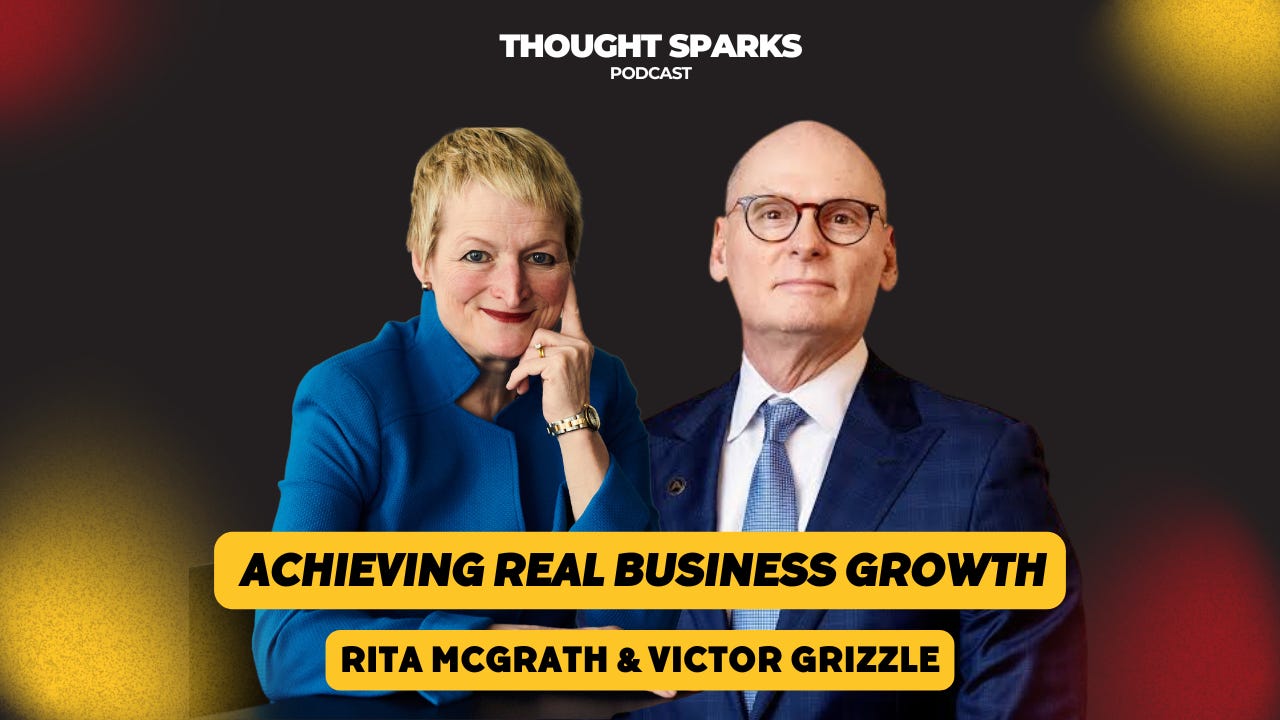
This week on the Thought Sparks Podcast, Victor—now executive chairman of Armstrong World Industries, the 160-plus-year-old ceilings leader recently recognized by Industry Week—joins me to tell the story from the inside. When he took the helm in 2016, Armstrong was, by his own account, a world-class business that didn’t grow. It had the highest margins in building products. It generated great cash per revenuedollar in the category, better than most. It boasted market-leading share. And it had a modest multiple on earnings, because shareholders had concluded the growth simply wasn’t there. The question on the table: is this as good as it gets?
What happened next is a masterclass in the growth outlier playbook, applied deliberately.
After arguing vigorously for a $100 million plant expansion in Russia and China expansion, he walked back into the same boardroom and recommended selling the entire international business to focus on North America. His leadership lesson is “it’s about getting it right, not being right.” It’s discovery-driven leadership in its purest form: when your assumptions change, your strategy must change, even if you were the assumption’s loudest advocate.
Armstrong’s organization had learned not to expect growth unless the market handed it to them. Victor treated growth as a mindset to be changed, not a behavior to be mandated. Working right at the edges of the organization, he connected with people three and four levels down. One mechanism was monthly departmental lunches where he could hear how people were actually thinking, not just the CEO-approved words they’d learned to repeat back.
When he and his CFO first asked for business cases, they got crickets. Nobody would bring an idea forward because they were too concerned about uncertainty and the possibility of failure. We talk about how he took the consequences out of intelligent failure—and how today the organization brings so many opportunities forward that they say no more often than yes. That’s exactly where a capital allocator wants to be.
Product vitality—the share of sales from products introduced in the past five years—went from the mid-teens to 40%. Armstrong brought twice as many new products to market as as they previously had. Competitors were reduced to fast followers.
Armstrong’s growth strategy leaned on bolt-on acquisitions of entrepreneurial companies in architectural specialties—which raises the eternal question: how does the big company avoid squashing the little one? Victor’s answer involves deliberate cross-pollination of talent in both directions, and it echoes what I saw at Klöckner in Germany: the moat is the core’s deep tacit knowledge, but the energy comes from the edges. They have to coexist.
We close with Victor’s advice to younger professionals navigating the AI era—his conviction that “the human element will win,” and why doing what you say you’re going to do has quietly become a career differentiator—plus his thinking on how a maker of physical ceilings stays relevant in a dematerializing world.
It is, I’ll admit, deeply gratifying to watch research become results. But more than that, this conversation is a rare, candid account of what the transformation actually felt like from the CEO chair—the board meetings, the middle-management resistance, the person who asked, “Can’t we just take a year off?” (Spoiler: you can’t.)
The episode drops on July 21 and is available on YouTube and wherever you get your podcasts. It’s a mini masterclass in leadership!