
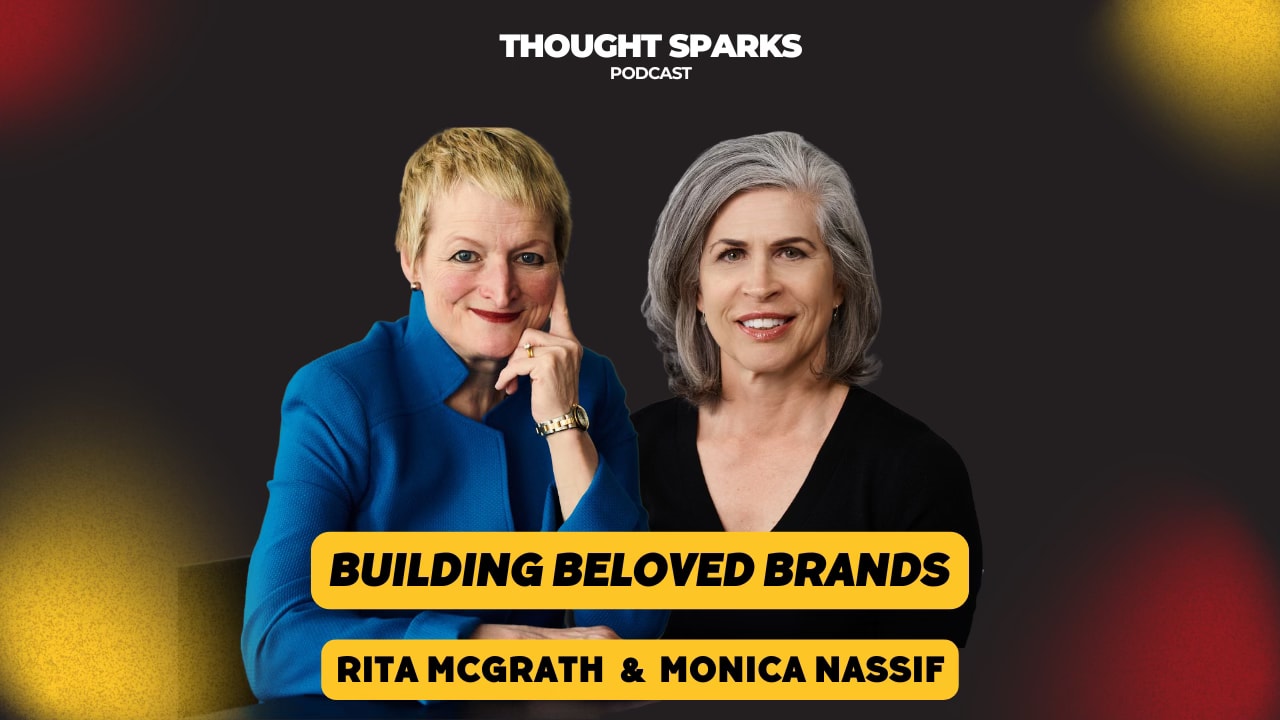
Did you know that the category-creating “Mrs. Meyer’s Clean Day” cleaning products were named after an actual Mrs. Meyer? Moreover, that she happened to be the mother of the company’s founder? Both true. Tomorrow, my podcast episode with her will be released, and I have to tell you it was a rollicking conversation.
So, on April 28th — which also happens to be the publication date of her new book, I Bottled My Mother: The Mrs. Meyer Story — Grit, Grime, and Growing a Business — my conversation with Monica Nassif goes live on Thought Sparks. And I wanted to give you, my Substack subscribers, a few reasons to tune in.
Monica is the entrepreneur behind two iconic household brands, Caldrea and Mrs. Meyer’s Clean Day. She was the first to see the opportunity in creating a new category – cleaning products without horrible chemicals and bad-for-you ingredients, all in the name of keeping things spic-n-span. What I found just as fascinating as the brand story is how strategically she built it.
Testing assumptions and Eureka moments
A point she emphasized over and over was the importance of getting at the story behind the story for entrepreneurs. She coaches them now, and commented that they often don’t think the idea all the way through. For example, if you want Target to sell your stuff, what stuff will they take off the shelf to make room for yours?
The concept for her brand came from what she describes as a Eureka moment. She was standing in front of a wooden pallet of garish cleaning products in an Atlanta store, thinking: what if this whole category could be like Aveda is in cosmetics? That single insight convinced her that it was a powerful enough idea to launch a company.
But whoa, she knew a lot about building brands, but didn’t know anything about building products. But she knew how to figure it out. As she recounts:
“I don’t know how to put liquids in bottles, but I knew Minneapolis was a rich town for that because of 3M, Ecolab, Minnetonka, Inc. Aveda, so there were a lot of people here who knew how to do that. So, I said to the guy who cut my hair, I said. Hey Mick, do you know anybody who knows how to put liquids in bottles? He goes, oh, I cut the hair of a fragrance consultant. I’ll set you up with her. So that was a fortuitous meeting. So I go see her and she kind of opens up this world to me…through her I met a manufacturer, a contract filler west of Minneapolis, and they used to do all the hair care for Revlon hair care products. So, I finally made a connection with them and I had this business plan, this PowerPoint, dummy bottles. I went out and showed her, and she, I’ll never forget, she leaned back in her chair and she goes:
“You’ve cracked the code. I’ve been waiting for someone to figure out this category and you did it. I’ll help you. So that was huge.”
Isn’t that a great story about making your own luck? I have to say, I never knew there was an actual occupation called fillers.
She then needed a chemist, someone who could create the actual product. The first couple she approached thought the idea was just bonkers, and turned her down. But eventually she found a fellow believer who began experimenting with different formulations, which she’d put into test bottles and run around to all of her friends, begging them to try the products out. Then they’d get feedback and on it went.
From Caldrea to Mrs. Meyer’s
Eventually, they launched what was a high-end brand, Caldrea, which was picked up by likeminded retailers like Restoration Hardware. But despite its success, she was uneasy. “Someone’s going to knock us off. I just, Iknew that 80% of all household cleaning products were sold at the mass level, at the Targets, the Whole Foods. And I thought, you know, if we don’t knock off ourselves, someone’s going to, and I’m not about to let that happen. We worked too hard. We got a great concept. The customer was really resonating to our idea that you could clean your entire home in one fragrance. So I wanted to take advantage of where the real volume was when I came to this type of product.”
Her mother had a role to play in that decision as well. Monica gave her a gift of some of the Caldrea items, which her mom liked, but thought they were too expensive. “I could never afford this. You need to make something for me.”
She deliberately cannibalized her own premium brand to create Mrs. Meyer’s before anyone else could do it to her. There’s a phrase her old boss used that she’s never forgotten: “Saw off the branch you’re sitting on, because it forces you to reach for the branch above you.”
What a great example of transient advantage thinking!
She walked away from distribution deals that didn’t let her brand block her products together on the shelf — even when cash was tight and any order felt like a lifeline. She pulled herself out of Target before Target could pull her out, preserving the relationship and eventually returning on much stronger terms. And she used a Williams-Sonoma private label deal as both cash flow and category validation — getting a better-resourced retailer to prove her concept for her.
None of these are textbook moves. They are the instincts of an entrepreneur.
Thanks, Mom!
Then there’s the book’s namesake: Thelma Meyer, Monica’s actual mother. One of nine children, raised during the Depression, running a household like a drill sergeant and a garden like a philosopher. Monica describes her as “the original Earth mother,” and the brand she built is essentially a tribute to those values — reuse, repurpose, care for what you have.
Mrs. Meyer is 93 and, according to Monica, is currently outworking her daughter on the book promotion circuit. I believe it.
This episode is equal parts business school case study and deeply human story about what it takes to build something from nothing, and then let it go.
I Bottled My Mother publishes April 28th. The episode drops the same day. I hope you’ll get to enjoy both.