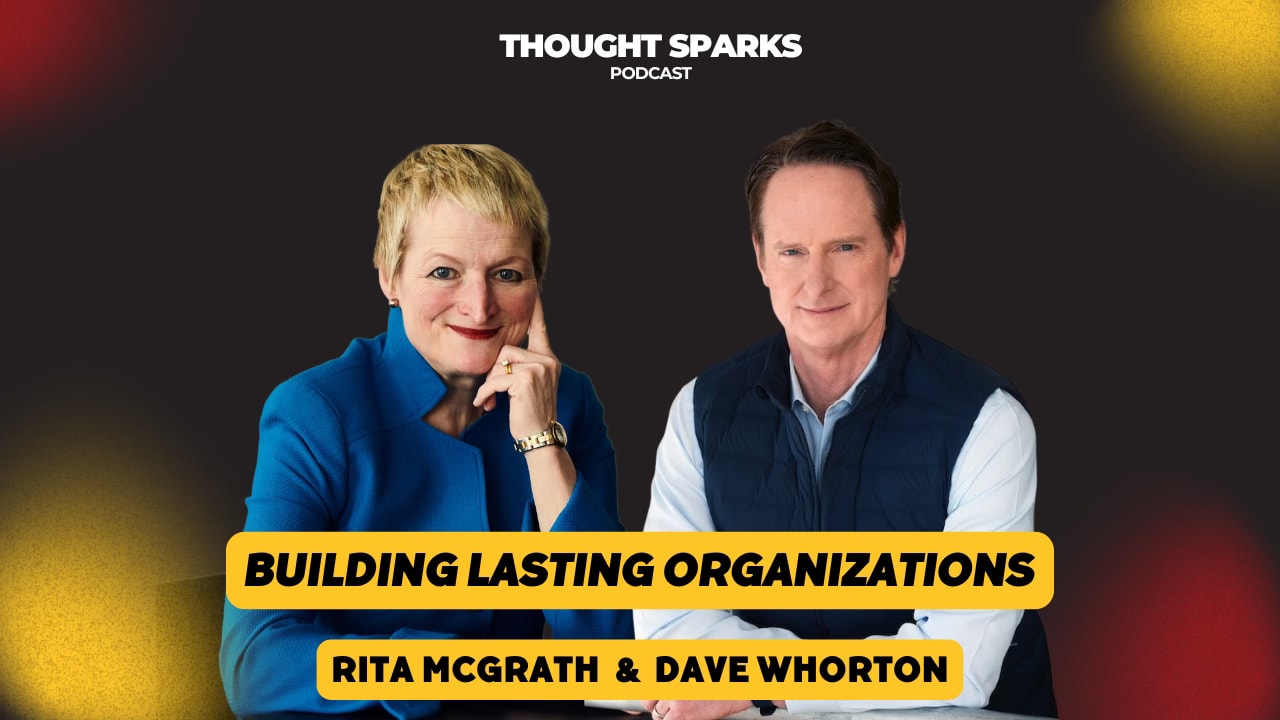
It’s easy to be cynical about the typical large firm in today’s economy. Many seem motivated by serving only investors, they’re laying off staff, they pay poorly and they’re skimping on doing the right thing for customers even as they grant huge salaries and bonuses to their managerial cadres. But if you look, you can find those that break this mold. Perhaps these can be our exemplars for a new Golden Age? Join Dave Whorton and myself as we explore what that looks like in the Thought Sparks podcast, releasing tomorrow.
Treating People The Way Bill and Dave Did
You’ve heard me talk about Carlota Perez’s framework explaining the process of technological revolutions. Every great surge of innovation eventually launches an irruption and installation phase, dominated by financial speculation and casino capitalism, and eventually a deployment phase, where the benefits of new technology flow broadly into the economy and society, a new golden age, if you will. The turning point between those two phases requires, among other things, capital being redirected away from financial manipulation and toward genuinely productive work.
My guest is Dave Whorton, co-author (with the legendary Bo Burlingham) of Another Way: Building Companies That Last and Last and Last, and founder of the Tugboat Institute.
Dave was inspired by his high school years working at Hewlett Packard when the company, with it’s “HP Way” defined what a good company looked like for a generation. As he says, “What I learned from the people on the manufacturing line at Hewlett-Packard was about Dave and Bill, and they talked about them with such reverence. It was all stories of how they treated people; it wasn’t about anything else but how they treated people. There were legendary stories inside HP for many, many years about how those two treated people.”
Eventually he moved into venture capital, with a career at the iconic Kleiner Perkins during the dot-com frenzy. He helped launch some iconic companies himself, and then in a moment of reckoning, looked at what venture capital had become and realized that what he was doing wasn’t building anything that lasts. His dream of creating a latter-day Hewlett Packard hadn’t been realized and what he was doing certainly wasn’t fulfilling that dream.
Finding Evergreen companies
Inspired by the ambition of Jessica Herrin to build a company with a 30-year growth trajectory that would generate billions and positive affect the lives of millions of women, he wondered if there was, indeed, another way.
He’d heard of two companies, the SAS Institute and See’s Candies that had become successful large companies without venture or investment funds, were beloved by their employees, and built solid and enduring relationships with their customers. He began looking for more. Through word of mouth, he found them. Eventually, they became members of what he came to call the Tugboat Institute, symbolism for the steady, invisible, but incredibly competent tugboats that keep things moving without drawing attention to themselves.
These were businesses that were purpose-driven, funded from their own cash flows, with no interest in going public or being sold. They were building something meant to outlast their founders. He started calling them Evergreen companies.
What makes them relevant to the bigger economic story I’ve been telling? Nearly everything, as they are living demonstrations that companies that nurture their people, care about their communities and share resources fairly can also be immensely successful.
Contrarian practices
These companies share their financials openly because they trust their employees to help. This is in complete contrast to Whorton’s previous experience, where he was steeped in Silicon Valley’s culture of closely-guarded numbers and strategic opacity. The Evergreen companies emphasized full transparency. If an employee saves a dollar of expense, that’s a dollar of real profit, and people can only help if they can see the scoreboard.
Their leaders invest in people for the long haul, running apprenticeships and multi-year rotations that have nearly disappeared from the more conventional corporate landscape. This compounds human capital the way Warren Buffett compounds financial capital. One company in Dave’s network has been operating for nearly 300 years (Ben Franklin was an early customer!) and today it makes advanced filtration systems for SpaceX rockets.
On talent, consider what Radio Flyer CEO Robert Pasin shared when Tugboat Institute members visited the company’s beautifully converted Chicago factory: most of their permanent employees come through their summer internship program. As Dave tells it, Pasin walked members through his onboarding frameworks, values documents, and process maps — and invited everyone to photograph everything and plagiarize freely, just remove his logo. And then shared his learning about his leadership pipeline, in which most of his people came through the internship program. As he says, “you can do all the interviews and assessments you want, but there’s nothing like watching a bright person work for ten to twelve weeks to really know what you have.” About fifteen member companies adopted the practice after that single visit.
Financially conservative
Evergreen companies, as Arie DeGeus initially found in his amazing study of “Living Companies” carry little to no debt. Rather than the tax-minimizing capital structures taught in our esteemed business schools or the extractive practices that are the hallmark of much private equity investing, leaders in these companies want to have a cushion against hard times. This is also strategic – if they have money in the bank when the next downturn hits, they can make acquisitions for rock-bottom prices and hire talent that would have been unaffordable otherwise.
We also get into some signature practices of our financialized economy: the 1982 SEC ruling that made stock buybacks legal (before that, it was considered market manipulation), the perverse incentives that rewards executives for driving up their own option values, and the asymmetry that lets private equity load portfolio companies with catastrophic debt at zero personal risk to the general partners, while the founder of a small evergreen risks her personal funds, sometimes even her house.
LLC’s rather than C Corps – an idea whose time is coming?
Today, the default path for company formation and growth is seldom questioned: incorporate as a C Corp, take angel money, set yourself up for venture capital, then an Initial Public Offering (IPO). That infrastructure — cap tables, investors, boards, quarterly earnings pressure, the whole governance apparatus — is taken for granted as the best way to organize a company’s people and resources.
But what happens if we make an LLC the default?
What if every company were an LLC, owned entirely by its members? No outside investors, no board in the traditional sense, ownership shared among the people doing the work, risk borne by the owners who also share in the gains. The complexity of public-company governance exists to protect outside shareholders — remove the outside shareholders and most of that machinery simply isn’t needed.
I asked Dave “why don’t we have these as the norm rather than the publicly traded company with investors howling every quarter?”
To which he responded, “In part because there’s such a powerful ecosystem that financially benefits from the current model. The valuation firms, investment banks, wealth management firms, venture capitalists — if the world was solely evergreens, there wouldn’t really be a role for them. As a tremendous amount of capital flowed into venture capital and private equity during the era of zero interest rates, there were in any one year ten times more funds raised than was actually invested in the first forty years of venture capital combined — just to give you a sense of the explosion.”
But think about it – once zero interest rates go away, energy becomes expensive and in which AI and dematerialization are collapsing the capital requirements for building real businesses, the LLC-as-the-norm might not be a radical idea at all. It might just be catching up to reality.
The power of role models
As I reflect on the malaise that seems to be hanging over many of our modern corporations, I found the conversation with Dave both stimulating and hopeful. If, as many, including Carlota Perez, believe, we are headed for a massive AI-fuelled bubble crashing, it will be vital to have examples of alternatives to the financialized modern corporation. Members of the Tugboat Institute might well offer shining examples.