2026 Yearoking Forward Newsletter
Most predictions are wrong. But it’s still important to pay attention to the weak signals of change. Here are five topics I’m watching in 2026.

What today’s great leaders really do
Debates about how best to mobilize the resources of large organizations have been going on for decades. No less than management legend Lee Iacocca espoused this leadership philosophy: “I hire people brighter than me and then I get out of their way.” You can think of this as “manager mode.”
But there is an increasing chorus of dissent about whether this approach is fit for purpose in today’s dynamic and unpredictable environments. With the company growing rapidly before the pandemic, Brian Chesky of Airbnb took the well-intentioned advice he was given to adopt “manager mode” behavior, only to see his company fragment. Nothing like a pandemic to create an existential wake up call. That led to his rethinking his approach. Where he landed was not to micromanage, but to become the keeper of first principles—deeply involved in product decisions, design reviews, and strategic direction while giving teams enormous autonomy within that frame.
He sparked a huge conversation with his comments about founder mode (a phrase coined by Y-Combinator’s Paul Graham). He stresses the importance of design sensibility (congratulations, Rhode Island School of Design). Rather than the hands-off style (remember the now fairly discredited idea of management by objectives?), he argues that?”Great leaders are in the details. That’s what founder mode is”.
As I was researching the leadership styles companies use to become more adaptive and “permissionless,” I too expected to find manager mode as the dominant form. Technology could do the job of what middle managers used to do, and there would be much more autonomy at the “edges” of the organization. But that model didn’t correspond to what I was seeing in many of the best performing companies. I’mthinking NVIDIA (top 5 things), Microsoft under “hands-on” Satya Nadella (not before that), Tesla, Amazon, Google, Shopify, Apple, JP Morgan Chase, Salesforce and many, many others. Even Walmart under Doug McMillon who “swears by collecting shopping carts.”
What I’ve concluded is that when the key challenge is inventiveness, rather than operations, founder mode seems to bring out the best in people. Consider Novartis, the giant pharmaceutical firm, which is “democratizing transformation.” CEO Vas Narasimhan champions an “unbossed” culture. Narasimhan has been bold about the strategic direction of the company, focusing it on innovative medicines and research. He’s present at committees in which key decisions are made. He’s also incredibly visible throughout the organization (I know very few CEO’s who are so adept at making short, relatable videos). Another effort I’m watching with great interest is Bill Anderson and Michael Lurie’s concept of “dynamic shared ownership” at Bayer, fundamentally changing the company’s operating system.
Founder mode involves creating clarity, bringing energy and establishing focus. It isn’t easy, but it offers the promise of leveraging what truly motivates people, according to Dan Pink. This is autonomy (Novartis’ ‘unbossed’), mastery (which Novartis calls curiosity) and purpose (which Novartis calls inspiration).
The Post-War Consensus Cracks
For decades after World War II, the Bretton Woods System, a remarkable institutional framework, governed the global economy. Organizations like the IMF, World Bank, WTO, and NATO created a stablearchitecture for trade, security, and economic cooperation. This consensus, which started eroding in the 1970’s, is now visibly fracturing.
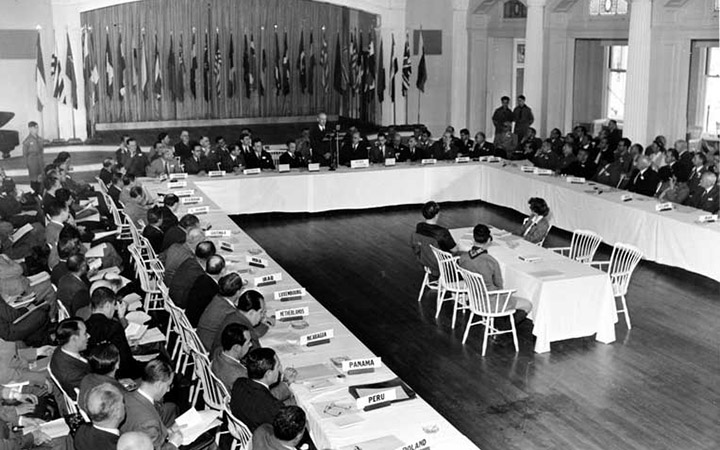
The symptoms are everywhere: trade wars, resurgent nationalism, the weaponization of economic interdependence, and the emergence of competing blocs. What’s remarkable isn’t that this is happening—Carlota Perez’s theory of technological revolutions would predict exactly this kind of institutional breakdown at the turning point between paradigms—but that we seem to have no united group of leaders to help us think through the design of what comes next. And Perez would argue that to usher in a potential Golden Age we need a proactive state to guide decisions made by government and by business leaders.
In the 1940s, a visionary group called the Committee for Economic Development brought together business leaders, academics and government policymakers to grapple with the question of what the post-war economy should look like. The immediate and pressing problem they saw was that as World War II ended, so too would the war contracts that provided many companies with stable demand that allowed them to make capital commitments to production. What, its architects wondered, could provide demand after war production ended?

The answer turned out to be bets on the creation of a stable middle class and housing (basically creating the suburbs through innovations like the 30-year mortgage). This drove second-order demand for things like automobiles and appliances. The other big thing was investment in science and scientific institutions to help the US stay ahead of Russia in the Cold War. The CED helped shape the institutional framework that served us for decades. It still exists, now as part of the Conference Board.
The question is whether the sense of urgency and consensus the original CED was able to summon will create the framework suitable for our current moment.
According to Perez, we are at a turning point comparable to the 1930s—the installation phase of the ICT revolution is over, we have massive income inequality and a glut of bad jobs, financial bubbles are bursting, and all the problems have emerged: inequality, regional devastation, populist leaders channeling the resentment of creative destruction’s victims. Indeed the Brookings Institute found that 44% of the American people work in jobs in which the median pay is $17,950 (that’s 53 million people). Stunning.
What comes next could be a sustainable global golden age that does for the world what the post-war boom did for Western democracies. As Perez argues, a golden age is “a positive sum game between business and society, orchestrated by government.” But it isn’t inevitable.
The choice is ours. But we need forums for serious people to think through what institutional frameworks will enable broadly shared prosperity in a digital, green, and increasingly multipolar world. That’s definitely on my agenda for 2026.
The End of Employment As We’ve Known It
While we’re on the subject of making a living, something fundamental is shifting in how people relate to work. Gen Z workers are increasingly turning down promotions out of a sophisticated calculation that the traditional bargain no longer makes sense. The additional stress, time commitments, and political navigation required for management roles simply don’t compensate for marginal increases in pay or status.
Companies have done a terrific job of teaching their people that there is no such thing as loyalty, and now employees are returning the favor.
The digital paradigm enables entirely different arrangements. Gig work, once seen as marginal, is increasingly mainstream. The “one-person unicorn” is no longer science fiction—individuals leveraging digital tools and AI can create value that once required entire organizations. Markets are emerging where skills are traded, projects are assembled, and traditional employment is just one option among many.Deborah Perry Piscione and Josh Dean, in their book “Employment is Dead” go so far as to argue that work will be completely reorganized.
For leaders, this means rethinking what it means to build an organization. The most effective companies will be those that can orchestrate talent across traditional boundaries—full-time employees, contractors, gig workers, AI agents—around shared purposes rather than hierarchical control. The organizational challenge of the next decade is invention of new models entirely.

America Cedes Ground in Green Technology
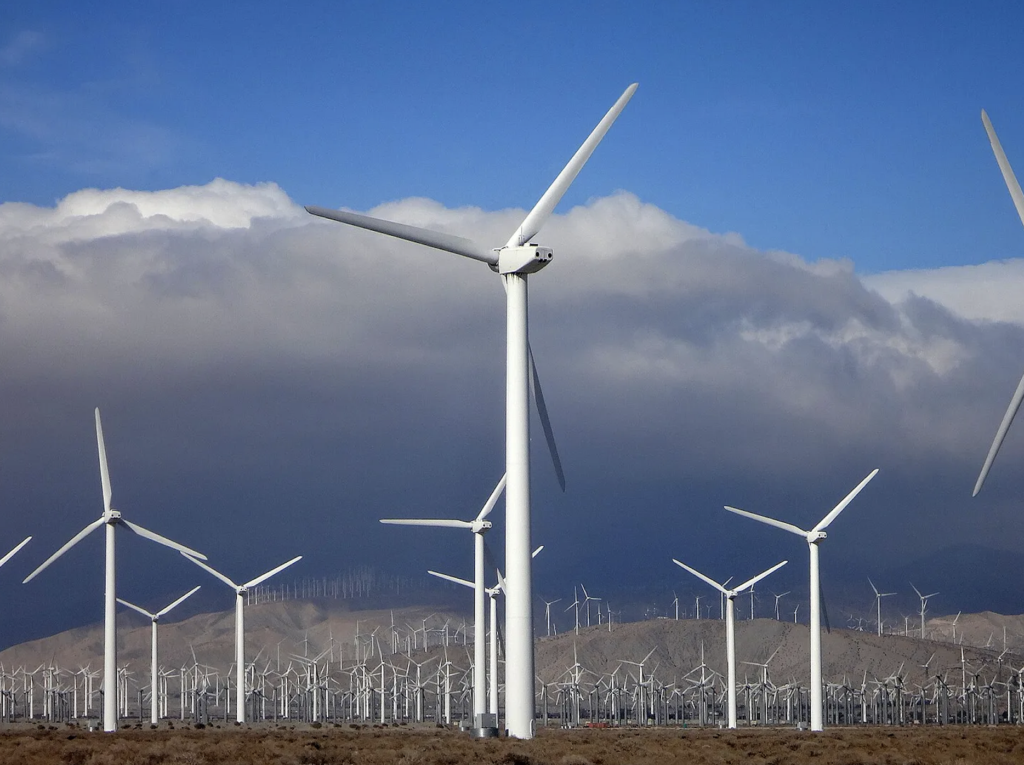
While debates rage over climate policy, a quieter but consequential shift is underway in green technology leadership. The United States, which once dominated clean energy innovation, is systematically dismantling its competitive position just as the market reaches an inflection point.
The numbers tell the story. China invested close to $680 billion in clean tech manufacturing in 2024—almost as much as the United States and EU combined. Chinese companies control the supply chains for critical materials: three-quarters of the world’s cobalt refining, 91 percent of graphite processing, and 92 percent of rare earth elements. Between March 2023 and March 2024, China installed more solar capacity than it had in the previous three years combined—and more than the rest of the world combined for 2023.
Meanwhile, the European Union has pledged to mobilize at least €1 trillion in sustainable investments to finance the European Green Deal. European policy is systematically creating the conditions for clean tech manufacturing to thrive, with coordinated investments, regulatory frameworks, and private capital mobilization.
Europe may surprise us all by leaping ahead. While America debates whether climate change is real, Europeans are building the industrial base of the 21st century economy. Economics and physics suggest it’s no longer a matter of whether the energy transition will happen. The question is who will lead it, who will follow, and who will be left behind.
The Global South Breaks Out
In 2004, my friend and mentor C. K. Prahalad published a book called “The Fortune at the Bottom of the Pyramid,” which makes the point that, approached in the right way, even people of few means can become customers, alleviating poverty along the way. It was based on an earlier article written together with Stuart Hart. He offered many examples of how smart companies achieve this, and today we’reseeing many more.
Consider the story of Zeno. Founded by an ex-Tesla employee, Michael Spencer, it is now commercializing electric scooters designed specifically for developing markets—vehicles built to carry multiple people over rough terrain, at price points that don’t require a subsidy and make sense for emerging middle classes. It is truly disruptive – making what was once complex (fueling a motorcycle) easy (swap out the battery) and what was once expensive affordable. By treating ownership of the battery separately from ownership of the vehicle, Zeno’s customers can spread the battery cost over time, opening up entirely new possibilities.
This pattern will repeat across sectors. The developing world represents enormous unmet demand. Healthcare, financial services, education, agriculture, transportation—in each of these domains, the Global South presents both the need and increasingly the capability for breakthrough innovation.
This could create enormous demand, reduce migration pressures, reduce greenhouse gas emissions and create jobs in the advanced world through trade and investment.
The opportunities for disruption are immense, and Zeno is a great example.

The Strategic Imperative
The leaders who thrive in 2026 won’t be those who predict the future correctly. They’ll be those who build the capability to sense these shifts early, experiment rapidly, and adapt as conditions evolve.
What are you watching in 2026? Let’s keep the conversation going.