Quick, when I say “annual budget,” what emotions does that invoke? All too often it’s somewhere in the neighborhood of dread and disinterest. In most companies, it’s pretty dysfunctional. But what would you do if you could prove that the months-long ritual that consumes thousands of hours of time and generates hundreds of PowerPoint decks, was actually destroying more value than it created?
At Bayer, one of the world’s great 160-year-old life sciences companies, that question got a radical answer: they just stopped doing it. In 2024, a process that involved five thousand people, started in June or July, and ran all the way to December was simply eliminated. As my guest tomorrow put it, about three percent of that process was actually useful. The other ninety-seven percent? Bureaucracy perpetuatingitself.
Building the Organization of the Future with Dynamic Shared Ownership
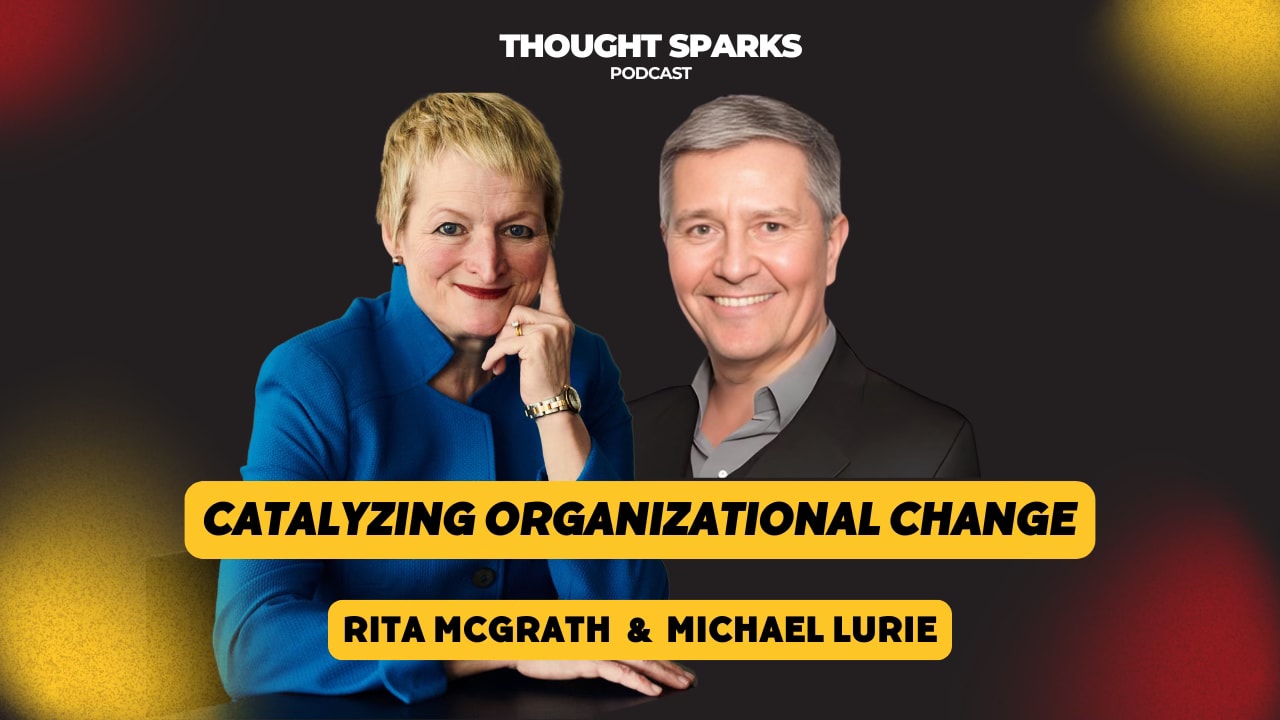
Tomorrow’s episode of the Thought Sparks Podcast is one I’ve been wanting to publish for a while, as it is a master class in courageous organizational change. My friend and colleague Michael Lurie is a formerMcKinsey partner. While there, he spent some 20 years perfecting a collaborative, anti-bureaucratic system that goes together with his ideas about the tasks in front of leaders (visionary, architect, coach and catalyst – VACC).
Michael is now the Chief Catalyst at Bayer, putting him directly in partnership with their CEO, Bill Anderson, specifically hired to turn around the troubled company. He’s been one of my intellectual sparring partners for years. We used to meet every two weeks with others in a small group to imagine what the future of organizations might look like. What makes Michael’s work so remarkable is that he’s now actually building that future inside a 160 year-old, ninety-thousand-person company operating across 120 countries.
The system is called Dynamic Shared Ownership (DSO). It involves breaking organizational silos into small teams, changing the organizational clock speed to operate on 90 day cycles and providing far more autonomy to those teams operating at the “edges” of the organization, a concept I’ve been suggesting is going to be increasingly important.
Does it work? When I first heard the performance numbers, I made him say them again.
The US Pharma organization, consisting of eighty to ninety customer teams, was growing at three to four percent a year. After DSO? Fifteen percent in 2024. Then they repeated it in 2025. That’s thirty percent cumulative growth in two years versus the five or six percent they’d historically have expected. A product team working on a drug called Nubeqa set an aspiration to hit just under a billion euros of revenue in 2025. They hit it by June. In another example, one manufacturing site cut costs by forty percent, improved quality, and watched employee engagement jump from twenty-five percent to seventy-five percent in two years.
Limiting the Return on Politics
We also get into something I’ve been arguing for years but have rarely seen actually executed: severing the link between hierarchical reporting relationships and compensation. Michael’s “Professional Homes“ model emphasizes skill-based career paths that sit entirely outside the line management structure. It’s one of the most thoughtful solutions to the return-on-politics problem one often encounters. When your raise doesn’t depend on making you look good to your boss, everything changes.
We also talk about strategy — what it means to push strategic thinking down to every team of eight or ten people, and why Michael believes the promise of DSO is creating thousands of entrepreneurial businesses that can also leverage the resources of a major enterprise. That framing connects directly to questions I’ve been exploring in my own work on what it takes to compete in an era of continuous disruption.
Stories of Permissionless Innovation
What I was struck by was how well the DSO system fits with what we know about how human creativity can be unleashed. If teams are offered agency (control), provided the chance to develop mastery (learning and growth) and connected to a larger mission, they can do astonishing things.
As Michael tells it:
Almost every week I hear just extraordinary stories. One that comes to mind is that of a customer team in Bangladesh growing at forty percent last year compared to ten percent previously. They think of themselves really as a business. They asked: as a business, what can we do to change the way our customers think about us? Their customers are smallholder farmers — many of them subsistence farmers in a developing economy.
The innovation they came up with was to create a football match (soccer, for American audiences) where one team was named after one of their products and the other team was named after another. They organized this match with uniforms bearing the product logos. Five thousand farmers and their families turned up. The brand awareness created and the product inquiries that followed were just one of several things this group of eight or ten people on the customer team innovated to turbocharge their growth as a little business. This was a group of people who had never done anything like this before. Just genius.
And there’s Michael’s observation about what he sees almost every week as he travels around Bayer’s global operations: a team of frontline manufacturing workers in overalls, standing in front of a screen displaying their key outcomes and metrics, having a completely sophisticated conversation about quality, speed, and economics. “There was no difference,” he said, “in commitment, expertise, seriousness, or dedication than you would see at the most senior levels in a leadership team.”
Bye Bye Bureaucracy
What I’m appreciating about this story is that when you remove the bureaucratic overhead that was actually preventing people from thinking, they think.
There is so much more in the episode than I can include in a short note. It’s hugely instructive.
The episode drops tomorrow, Tuesday May 5th. I hope you’ll listen — and I’d love to hear what it sparks for you.
— Rita